If legalization is a big topic for you this November, you should know who to vote for. Mitt Romney and the Republicans are against the legalization of marijuana even for medicinal purposes, stating "There are synthetic forms of marijuana that are available for people who need it for prescription. Don't open the doorway to medicinal marijuana." So if you are a big advocate of cannabis, then this might be something to consider if you are leaning Romney.
Obama, on the other hand, isn't going to be able to legalize the substance any time soon, but would like to decriminalize it, and "treat it like a public health program". While this wouldn't be as drastic as make it completely legal, it is still quite contrasting from Romney position of making it illegal altogether.
Just something to think about when voting in two weeks.
Sunday, October 28, 2012

Response to Your Comments
Christal, thanks! It sure as hell is a good blog. We have included quite a few in-text links to help support our facts so you know they are legitimate.
Melody, thanks to you as well. The link you provided, however, makes the point that marijuana is not a gateway drug, and that is not an argument we are trying to make. Here is our stance on that matter as stated in our post “While it may be possible that marijuana can act as a “gateway drug”, the fact remains the legality, or lack thereof, has little to no effect on the drug’s popularity or availability among many places in society”. In addition, your link is not credible enough to be used as evidence on our blog. We don’t really trust “Nydia Swaby” or her Marijuana Policy Project, as it seems quite biased.
Moni, when you said “this is a good blog”, you were exactly right. You also might be right when you said “the government wouldn’t crack or heroin”. We don’t think they would crack or heroin either.
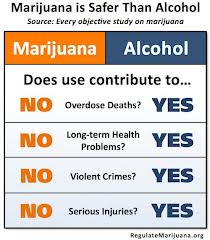
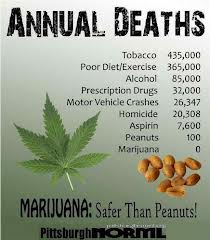
Also, "Marijuana is actually more dangerous than alcohol and tobacco"? Tobacco has been the cause of 435,000 deaths a year, and alcohol is responsible for another 85,000. Marijuana has a grand total of 0 recorded deaths. That is less than peanuts. Here is further proof of marijuana being safer than alcohol.
Finally, your link is about how marijuana is a gateway drug, which is completely unrelated to the argument that your post made.
Joe, while our blog was a bit wordy at some parts, those are called "facts". We feel like the phrase “As a widely used product, the financial potential behind this could prove immensely beneficial to our troubled economy” might be a little wordy, but it is the best way to explain how marijuana could benefit the economy. However, the graph you included would be beneficial to someone who is more inclined to just scan the blog for facts and images. Thanks for your input.
Alec We noticed that you said “I have no clue whether you’re for or against or for marijuana”, but literally the very first sentence of our blog says “ the substantial economical and medical benefits, and lack of significant drawbacks, support the notion of reformation in current marijuana legislation”. How can you possibly not tell if we are for or against marijuana? You also say there is "no viable scholarly backing" to our bases on Alzheimer's Disease. Researchers at the Scripps Research Institute in California have a different opinion.
You’re right, our roadmap does go from health benefits to students acquiring drugs. Maybe you forgot to read the first sentence of the paragraph demonstrating how the two are related. Here it is again since you seem to have missed it the first time: “These points show the higher potential for improvements to public health, but possible benefits is often outweighed by speculation over whether or not marijuana might lead to use of harder, more harmful drugs.”
As for your boredom, I apologize that you had to read some facts about marijuana on a blog about marijuana. Also, your examples of us providing “jumps in logic” are, in fact, not jumps in logic. You then went on to write this gem of a sentence: “That caused by this huge road map, readers won’t want to read.” We literally have no idea what that means. In addition, we are glad that you were “more interested with the videos on our sidebar”, although we aren’t quite sure what you are talking about, seeing as there are no videos in the sidebar. Thanks for all your great points though.
Melody, thanks to you as well. The link you provided, however, makes the point that marijuana is not a gateway drug, and that is not an argument we are trying to make. Here is our stance on that matter as stated in our post “While it may be possible that marijuana can act as a “gateway drug”, the fact remains the legality, or lack thereof, has little to no effect on the drug’s popularity or availability among many places in society”. In addition, your link is not credible enough to be used as evidence on our blog. We don’t really trust “Nydia Swaby” or her Marijuana Policy Project, as it seems quite biased.
Moni, when you said “this is a good blog”, you were exactly right. You also might be right when you said “the government wouldn’t crack or heroin”. We don’t think they would crack or heroin either.
Also, "Marijuana is actually more dangerous than alcohol and tobacco"? Tobacco has been the cause of 435,000 deaths a year, and alcohol is responsible for another 85,000. Marijuana has a grand total of 0 recorded deaths. That is less than peanuts. Here is further proof of marijuana being safer than alcohol.
Finally, your link is about how marijuana is a gateway drug, which is completely unrelated to the argument that your post made.
Joe, while our blog was a bit wordy at some parts, those are called "facts". We feel like the phrase “As a widely used product, the financial potential behind this could prove immensely beneficial to our troubled economy” might be a little wordy, but it is the best way to explain how marijuana could benefit the economy. However, the graph you included would be beneficial to someone who is more inclined to just scan the blog for facts and images. Thanks for your input.
Alec We noticed that you said “I have no clue whether you’re for or against or for marijuana”, but literally the very first sentence of our blog says “ the substantial economical and medical benefits, and lack of significant drawbacks, support the notion of reformation in current marijuana legislation”. How can you possibly not tell if we are for or against marijuana? You also say there is "no viable scholarly backing" to our bases on Alzheimer's Disease. Researchers at the Scripps Research Institute in California have a different opinion.
You’re right, our roadmap does go from health benefits to students acquiring drugs. Maybe you forgot to read the first sentence of the paragraph demonstrating how the two are related. Here it is again since you seem to have missed it the first time: “These points show the higher potential for improvements to public health, but possible benefits is often outweighed by speculation over whether or not marijuana might lead to use of harder, more harmful drugs.”
As for your boredom, I apologize that you had to read some facts about marijuana on a blog about marijuana. Also, your examples of us providing “jumps in logic” are, in fact, not jumps in logic. You then went on to write this gem of a sentence: “That caused by this huge road map, readers won’t want to read.” We literally have no idea what that means. In addition, we are glad that you were “more interested with the videos on our sidebar”, although we aren’t quite sure what you are talking about, seeing as there are no videos in the sidebar. Thanks for all your great points though.
Tuesday, October 23, 2012
Recent News On The Marijuana Debate

This link provides an arguement for why Oregon voters should lean toward the legalization of marijuana, and show the possible positive impacts marijuana could have on the people and state. Also, it addresses that the legislators try to avoid the topic of the legalization of marijuana because of how controversial the debate is. If legislators are trying to stay away from the debate on marijuana, could that be a road block to the legalization of marijuana?
A Federal Court of Appeals session on Tuesday made history as Americans for Safe Access presented evidence that cannabis should be removed from schedule 1 of the Controlled Substances Act. The evidence found, is making it harder for organizations such as the Obama Administration to disregard the medical proofs of marijuana's healthy benefits.
Sunday, October 14, 2012
The Benefits of Legalization
Through an increase in the knowledge base surrounding marijuana, the substantial economical and medical benefits, and lack of significant drawbacks, support the notion of reformation in current marijuana legislation. This reform would restrict consumption in any instances that endangered the wellbeing of any individuals, but would still defend the basic freedoms that are part of this country. America was structured in a way that protected its citizens against oppressive laws and inhibition of liberties, yet we still have legislation in place that prohibits americans from right to express their personal freedoms.
Still, one might argue that the preexisting legality of other more harmful substances does not serve as valid justification to legalize cannabis use, but in fact, marijuana can actually prove beneficial in certain areas. In the health field, for example, cannabis can be used as a muscle relaxer, which helps in treatments of Multiple Sclerosis, seizures, and Tourette's Syndrome. The appetite boosting effects also prove promising in use with cancer patients who are struggling to eat. Further, THC, the active ingredient of marijuana, blocks deposits in the brain that cause Alzheimer’s Disease.
So, if cannabis will continue to be used regardless of whether it is legal or not, it would make sense to provide it in a safe, controlled manner. By distributing the substance from government sanctioned dispensaries, the product could be properly regulated, so consumers know exactly what they are purchasing. This would also eliminate interactions with criminal drug dealers, and any hazards that accompany nefarious activities. In addition to increased safety, dispensaries would also present the opportunity to enact a tax on the sale of marijuana. As a widely used product, the financial potential behind this could prove immensely beneficial to our troubled economy. Similar to the current state and federal taxes on alcohol and tobacco, such excised good can generate a significant increase in revenue. This additional income could be used any number of areas in society that could use extra income. In the example of Amendment 64 in Colorado, tax revenues would go towards programs involving substance abuse prevention and research, increased funding for the public education system, and more widely accessible healthcare. The economical benefits go beyond simply generating more income, as they would allow us to save money as well. Currently, a substantial amount of tax payer’s dollars are going to pay for inmates jailed on petty cannabis charges. These individuals pose little actual threat to society, yet are expensive to keep in correctional facilities. Furthermore, their absence would free up spaces in overcrowded prisons, allowing room for more dangerous or threatening criminals.
Yearly Arrests Related to Marijuana
Americans still maintain this freedom of choice in similar areas, such as alcohol and tobacco, but there are restrictions put into place that help prevent danger to those around them. Such limitations include laws governing driving while intoxicated, and smoking in certain areas such as airplanes, gas stations, or near schools. These regulations are designed to make sure that citizens can exercise and enjoy their right to choose, but that general public safety is still intact. Despite the vast amounts of evidence detailing the harmful effects of both alcohol and tobacco, citizens are still allowed to choose to partake in the use of these substances. Marijuana, on the other hand, is less harmful than both of these substances, yet is completely federally prohibited.
Health Benefits of Marijuana
Source. October 14, 2012
These points show the higher potential for improvements to public health, but possible benefits are often outweighed by speculation over whether or not marijuana might lead to use of harder, more harmful drugs. While it may be possible that marijuana can act as a “gateway drug”, the fact remains the legality, or lack thereof, has little to no effect on the drug’s popularity or availability among many places in society. One study shows that, among American teenagers, 40% said they could obtain marijuana within a day, and 25% said they could acquire it in under an hour. The survey went on to provide data showing that, in "teens between the ages of 12 and 17 say it's easier to get marijuana than buy cigarettes, beer, or prescription drugs". These figures illustrate that, despite the law's stance on marijuana, it is still readily available to a significant portion of the population. In this sense, any gateway effects of marijuana are largely unrelated to the legislation surrounding its use, as legality has very little influence in its presence or availability.
Availability of Marijuana Percent of students who reported easy availability of substances at school, by student's grade level. Source: U.S. Department of Education, National Household Education Survey, Youth interviews, spring 1993 |
Yearly Arrests Related to Marijuana

The positive effects outlined above, including benefits in logistical, medical, and economic areas, provide substantial evidence that the government sanctioned use of cannabis in a safe and responsible manner would prove immensely advantageous to many problems that plague American society today. Consequently, we feel that the government should rethink its policy on marijuana. Much like alcohol, the substance should be legal to those over 21, with restrictions placed on things like smoking while driving and smoking around schools, hospitals, etc. In this sense, people would be free to enjoy their freedom of choice, but must do so in a way that does not endanger other people.
Subscribe to:
Comments (Atom)